And getting right in to it, it was all about rethinking perspective.
Whatever your ‘thing’ is, battling with the usual doubts of not always having the drive to stick to it, believing you’re lacking the talent to do it, or the time to complete it, will probably plague you throughout it all. And sometimes, that could be months, if not years. Recognize it. You’re not alone. You’ve still got time to pivot and get that win.

For me, I love to write, and want to write, but that wasn’t nearly enough to significantly cut down the time it took for me to get to a solid first draft of my book. The draft I know that will be red-penned. Underlined and highlighted, and handed back to me without a visible piece of the original white printer paper from all the black and blue comments. Now, something is wrong with me, as it’s a little twisted how I get a kick thinking about what ways my Amazing Beta-Reader Babes will edit the stank out of it… for my benefit, of course. Remember this when I’m finally at that point, and after thanking My Girls for all their time, and thorough critique, I’m instead crying snots under the streaming water in my shower at my hacked-to-pieces work. Bloody Nit-Picking Bitches!
And now pulling myself together… highly successful authors have long admitted that their first novels were pretty dreadful in reflection. Then, in the same breath as they laugh over its expected failure, also credit its role in the success of their future work. For what reason? Because they learned from it. And to learn from it, you need to finish it. Once I let that cement into my brain, I realized I need to do the same and complete it. Meaning, I had to make it good enough for where I am now with my writing skills at rock bottom. No shade to me, just reality.
Embrace the mantra ‘I will not please everyone.’
I’ve done online book clubs before, and was actually in a local one for about five years. And while the medium differed, nothing teaches you more about perspective than listening to groups of women who’ve all read the same book, share wildly different opinions. At times, things seem normal. Observances and some plot twists are recognized and shared by the collective. Example: A character who killed his mistress to silence her before she could inform his wealthy and connected wife equals a universal reaction and agreement that he is the bad guy. 1+1 = 2. Good. Great. But then there’s this one scene in another novel, where the masked killer is running around a field at night trying to decapitate a group of campers, all of whom are strangers to her. But she fails and retreats to her basement until the following night, when she tries again. 90% of the group are rightly horrified and label her as a psycho. Then here comes a “Yeah, but…” from the remaining 10%. Suddenly, there’s visible confusion and now 1+1 = cake. The 90% are staring at the vocal leader of the 10 percenters like, ‘umm… is this why we’ve never hung out in your basement, Stacy?’ The back-and-forth banter heats up around the many reasons for their take. Comments such as, “this is not: Janie likes apples but Jessie likes pears, this is a recurring premeditated murder!”, make some hold fast to their original conclusion. But not all. In fact, a few of the OG 90% have flipped their script. They digested the new viewpoints and now are siding with the psycho-killer and the character’s rationale to why they might have acted as they did. And why? Perspective.
Using and understanding how perspective shaped, and could change, how people interpreted a character’s action or parts of a book, led me to see how I could use it to write, and finish, mine.
OK, let me back up a bit.
Go with me for a minute. There’s approximately eight billion people on the planet. Over 360 million in the U.S. alone, where I currently live. I’ll not do the numbers, but nowhere near a sliver of 0.000001% of those massive numbers are readers who’ll ever even know of my book’s existence. Next, subtract my friends and fam who’ll do me a solid and buy a copy of my book realistically out of sheer pity (I humbly thank you… and also, rude.) Now thinking of who’s left. Those who do manage to put hands on my paper-baby. I can’t even wrap my brain around the vastly different opinions they’ll have over it. Worrying over making my book as perfect as it could be meant crippling myself trying to satisfy the impossible. To the best of my ability, I could map out a character’s trait that is clear, at least to me, is the good guy or girl. And despite that, some might still find them nauseating. I’ve rewritten characters, changed locations, and scrapped entire plots. And every time I did, I paused, lost momentum, and even more confidence. I know where I want my story to go. The characters and themes I’m exploring. But I could not gauge how a reader will take or interpret something. So, I had to stop fixating on making my writing fit or fill something completely outside my control. Ultimately, what brought me back was a change in my perspective.
Now, not only am I excited to finish it, I’m kind of looking forward to those different takes. Such critique will only help shape the next book or short story. The one I plan to write a lot faster, now that I’ve made every damn mistake imaginable and wasted too much time on strategies, tools, and all manner of foolishness I didn’t even need.
That’s not to say I’m excusing bad writing. Neither will those Hoochies. The so-called friends of mine, and their clicking red pens (I love you all!). If something in my writing is universally confusing or just doo-doo, that’s different. Nope, I don’t want that. I’ll clean up messy language and fix weak scenes, etc. I’ve also read the hyped-up books I thought were rubbish. And loved the ones people thought were “Eh”. Accepting that my book might make someone want to hurl it clear across a room, well, that’s okay. Or worse, want to set it on fire… I’m looking dead at you, Anne Rice’s The Claiming of Sleeping Beauty! AKA Beelzebub’s reading companion.
So how did I trick myself into finishing?
- By accepting that I can’t shape-shift my book to be my target audience’s absolute cup of tea.
- Embracing the truth that not everyone will get what I think they’ll get or interpret it the way I intended.
- Knowing a solid number of folks will absolutely hate it, and… and it won’t kill me.
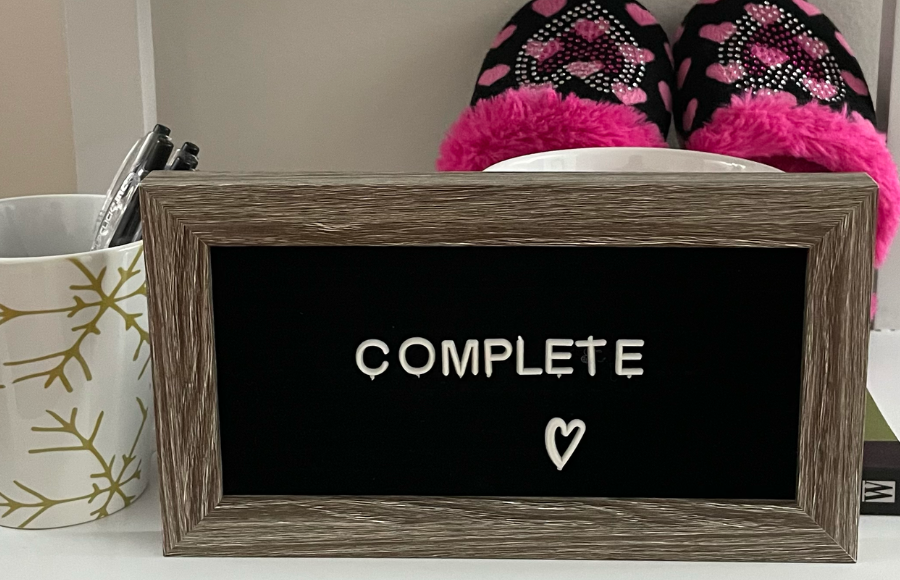
- With my word of the year reminder: “COMPLETE”, that ambushes me every time I enter my makeshift office, and continues to bore into the back of my head as I type. I swear I can feel it.
- And always reminding myself that I’ll gain nothing unless I finish.
Writing my first book is teaching me many things, but above all else, how to finish. It was all about rethinking perspective.